 WebReview
As an Amazon Associate I earn from qualifying purchases. Links below are affiliate links; the price you pay is unchanged.
Basis: BLUETTI's Elite 100 V2 user manual (V4.0), the Amazon listing, and the supplied product image. WebReviewStar has not independently tested this unit.
Review summary
The short answer
Buy it over the Jackery if your load is 1500–1800W, if you want 140W USB-C, or if a 10ms switchover matters to you. Skip it if you expected to protect a workstation — the manual carries the same warning the marketing does not.
Buy it if
- You need 1800W, not the 1500W the Jackery offers at the same capacity
- A 10ms UPS switch is meaningfully better for your equipment than 20ms
- You want 140W USB-C for a laptop, which is unusually high for this class
- Portability matters: 25.3 lb against the Jackery's 23.8 lb is close, but the 17L shape packs differently
Skip it if
- You are protecting a server or workstation — see the warning below
- You want the 4000-cycle figure Jackery states and BLUETTI's manual does not
- 1000W solar input is not enough and you planned around more
- You need >1024Wh; both units are about a kilowatt-hour
What it actually is
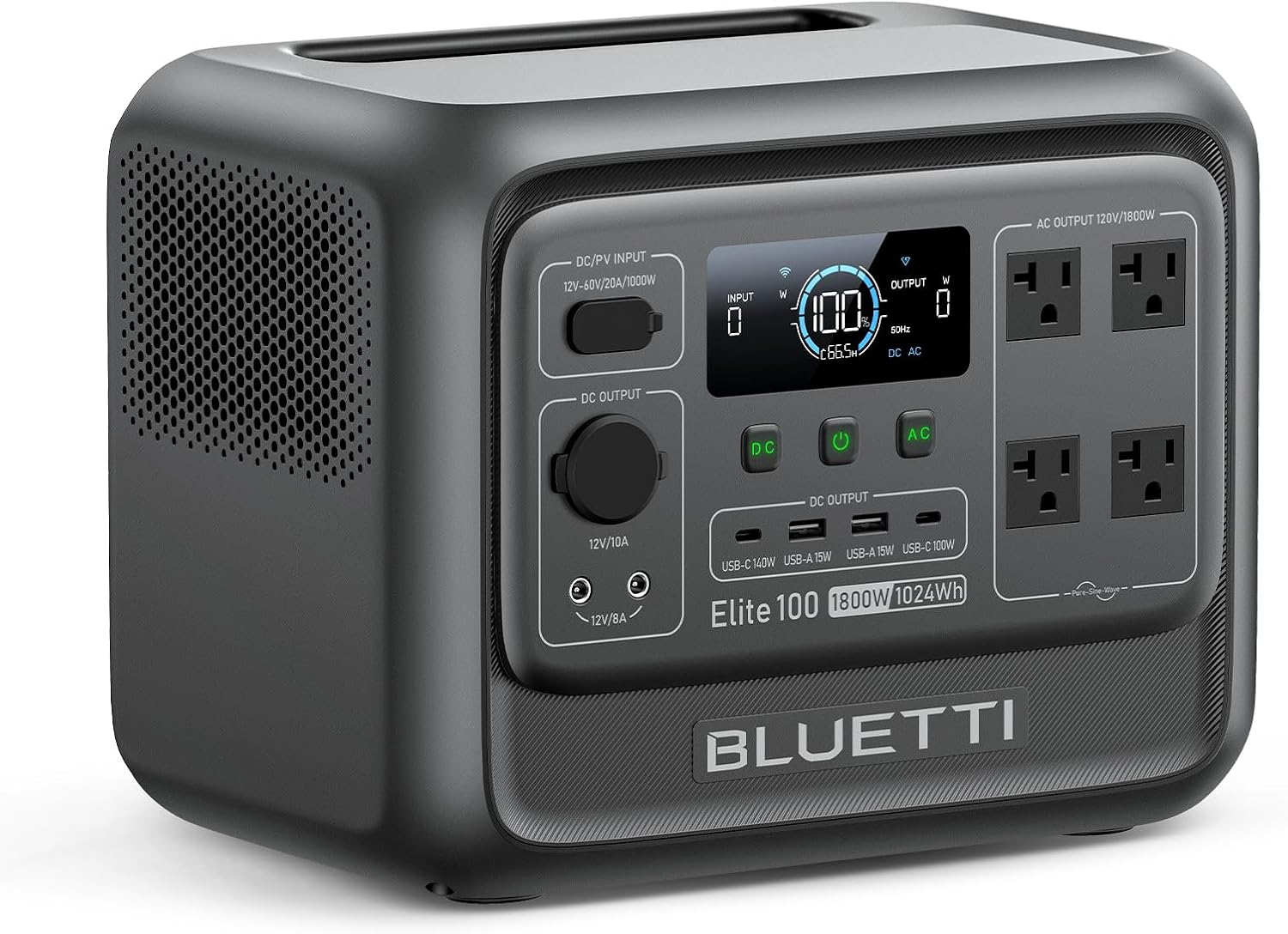
A 1024Wh LiFePO4 power station rated at 1800W continuous, with three AC outlets, two USB-C ports at 140W and 100W, two USB-A, a cigarette lighter socket and two DC5521 ports. The manual's own specification table confirms the numbers.
It is the same capacity and roughly the same price as the Jackery Explorer 1000 v2, which is why it deserves its own review rather than a footnote.
The three numbers that differ
At identical capacity and near-identical price, the comparison reduces to three specifications:
| AC output | **1800W** (2700W lifting) |
|---|---|
| UPS switchover | **≤10 ms** |
| Best USB-C | **140W** |
| Weight | 25.3 lb / 11.5 kg |
| Noise (manual) | 50 dB max |
Output: 300 watts is the difference between running a kettle and tripping. It is the most practical advantage here.
Switching: this is the number that decides whether the thing is a UPS or a standby battery. 10ms usually rides through a desktop power supply; 20ms usually does not.
At the same price and capacity, ten milliseconds against twenty is the whole argument — and it is the sentence the marketing department cannot legally write for the cheaper unit.
USB-C: 140W is unusually high and genuinely useful. It is enough to fast-charge a MacBook Pro on its own, without touching an AC outlet and losing inverter efficiency.
What works
- 1800W rated with a stated 2700W Power Lifting figure
- UPS switchover of 10ms, stated in the manual's own specification table
- 140W USB-C plus 100W USB-C, both genuinely high for the class
- LiFePO4 with 4000+ cycles claimed on the listing
- 1200W AC charging reaching 80% in about 45 minutes
What doesn't
- The manual warns against servers and workstations, same as the Jackery
- Manual states 50dB max noise, while the listing says 30dB in silent mode
- 4000 cycles appears in marketing, not in the manual's spec table
- Cigarette lighter and DC5521 ports share a 10A total
The warning both brands print
Both manuals carry the same restriction, and neither listing does:
"Attention: Not for devices like data servers or workstations that require high-performance UPS." — BLUETTI manual
"Do not connect to equipment with high uninterruptible power requirements such as data servers and workstations." — Jackery manual
So the 10ms advantage is real but narrower than it looks. Both companies are saying: this is not a UPS for a computer you care about. The 10ms unit is simply closer to being one.
That consistency across two competing manufacturers is worth knowing, because it means the limitation is physics rather than brand caution. Power stations use relays; online UPS systems do not.
Where the manual and the listing disagree
Noise. The listing says 30dB in silent mode. The manual's specification table says 50dB Max. Both can be true — 30dB is a claimed best case in a specific mode, 50dB is the ceiling — but if you are buying this for a bedroom or a tent, plan around the 50.
Cycle life. The listing claims over 4,000 cycles. The manual's specification table gives no cycle count at all, only the guidance to fully cycle every three months to maintain health. The 4000 figure may be perfectly accurate; it is also not documented in the place a specification should be.
Solar and charging
- AC charging: 1200W, reaching 80% in roughly 45 minutes at 25°C
- Solar: 1000W max, 12–60V, 20A. Do not exceed 60V open-circuit — the manual says so twice
- AC + solar together: 1200W combined ceiling
The 1000W solar input is generous for this class and is the figure that makes the unit plausible as an off-grid component rather than an emergency box.
Who it is for
Someone who wants about a kilowatt-hour of LiFePO4, needs 1800W rather than 1500W, and considers 10ms meaningfully better than 20ms for a router, a modem or a laptop.
Not someone protecting a workstation, and not someone flying anywhere with it — at 1024Wh it is several times over any carry-on lithium limit.
Questions
Is the UPS switchover really 10ms?
Yes, and unlike most competing listings the manual's own specification table states it: "Switchover Time: ≤10 ms".
Can it run a desktop PC or server?
The manual carries a warning not for devices like data servers or workstations that require high-performance UPS. A desktop PSU at 10ms is more likely to ride through than at 20ms, but do not treat it as guaranteed.
30dB or 50dB?
The listing says 30dB in silent mode; the manual's specification table says 50dB Max. Those describe different conditions, and the manual number is the ceiling.
How many cycles?
The listing claims over 4000. The manual's specification table does not state a cycle count, only that you should fully cycle every three months to maintain health. Treat 4000 as the manufacturer's marketing figure.
Can I take it on a plane?
No. At 1024Wh it is far above the 100Wh carry-on limit. These are road and camping units.
Sources
The bottom line
If it suits how you actually use your network, this is the one to buy.
Check price on AmazonWas this review useful?
Thanks — that helps.
Comments
No comments yet. If something here is wrong or missing, say so — corrections get fixed.